Skills Matrix
What is the Skills Matrix?
The Skills Matrix is a set of evaluations that allows coaches and associations to identify areas of strength and skill development for individual athletes, teams, and associations for age divisions U12 (Provincial and Regional), U10, U9, and U8.
Why do I need to do this??
The Skills Matrix Evaluations allow:
- Athletes to be appropriately placed on teams where they can develop collaboratively under the direction of coaches
- Coaches to target areas of skill development in order to increase the proficiency of their athletes
- Associations to develop on-ice programming to address wide-spread areas of improvement (e.g., power-skating, passing and/or shooting clinics, etc.)
- Regions and Leagues to ensure the appropriate placement of athletes on teams and teams in loops or tournament groups
-
What is the Sport Development Committee doing to improve this process?
We are a group of experienced and dedicated members of the ringette community including athletes, coaches, officials, parents, and association volunteers.
We are committed to implementing the Sport for Life philosophy, which includes the LTAD principals, to the benefit of all athletes in Ontario.
We are working to improve by:
- Allowing players to develop in all facets of the sport through evaluation and development of all necessary skills
- Providing coaches with concrete feedback and the tools to help their athletes grow and develop in the sport (e.g., the Drills for Skills packages available at: https://ontario-ringette.com/coaching/Resources.php?sub=coaching)
- Improving consistency of evaluations across regions and the province by:
-
- Ensuring a standard on-ice evaluation outline to be implemented in each association in the province
- Making the Skills Matrix videos available in order to base all evaluations on the same standards (http://www.youtube.com/channel/UCWGddPSY6p6_X8wQqe1csPw)
- Providing support and resources to evaluators (from your Sport Development Coordinators)
-
What does each association need to do?
Ensure that every player in the U12, U10, U9, and U8 age groups in Ontario are evaluated using the attached Skills Matrix. There are four stages and progressions of skill development. Understanding the stages of skill development is necessary for coaches and parents to ensure an athlete acquires skills in the proper order. The following terms used in the Skills Matrix explain the stages of skill development that a Ringette player will progress through when learning technical skills. The Skills Matrix uses a grading system numbered 1 to 4.
1 Initiation -First contact with the skill
Training Emphasis: Basic stances and positions. Getting the idea of what the movements are about and look like.
2 Acquisition -The athlete can coordinate and execute key components in the correct order.
-Timing of the skill lacks synchronism, rhythm, and flow.
-The athlete needs to think about what they are doing during the execution of the skill.
Training Emphasis: Global Execution and general form of movement.
3 Consolidation -Performance is inconsistent but movement is starting to show coordination.
-Skill is performed with rhythm under stable conditions.
-Some elements of performance are maintained (when the athlete is under pressure, conditions change or demands increase).
Training Emphasis: Maintaining the form and movements and some performance consistency under a variety of conditions under stress.
4 Refinement -Performance is very consistent and precision is high in demanding conditions.
-Movements are automated with only minor fine-tuning necessary.
-Critical reflection and correction is possible by the athlete.
Training Emphasis: Creating conditions that stress the specific elements that need adjustments.
Each association with teams participating in the above age groups will be required to conduct an evaluation for each player using the skills matrix. The evaluations will then be used in the formation of teams.
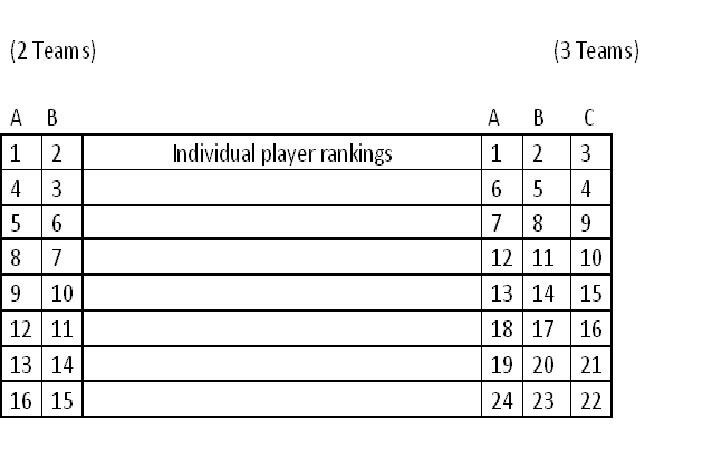
In the event an association is going to ice two or more teams in the U9/U10 division, the players must first be divided by age to determine if there are a sufficient number of players registered to meet the Viable Team Guidelines, as set out in the ORA Operating Manual.
If there is an insufficient number of players in one age group, the player evaluations must be used to form a combined team based on the following ranking formula, regardless of the age.
Skills Matrix Video

Check out the Ontario Ringette YouTube page to access the Skills Matrix Videos created to assist in the Skills Matrix process.
Skills Matrix Templates
How To Run Skills Matrix Evaluations for 2015/2016 Season
|